
 Skip to content


Flatbed vs. Wheel-Lift Towing: Which Is Right for You?
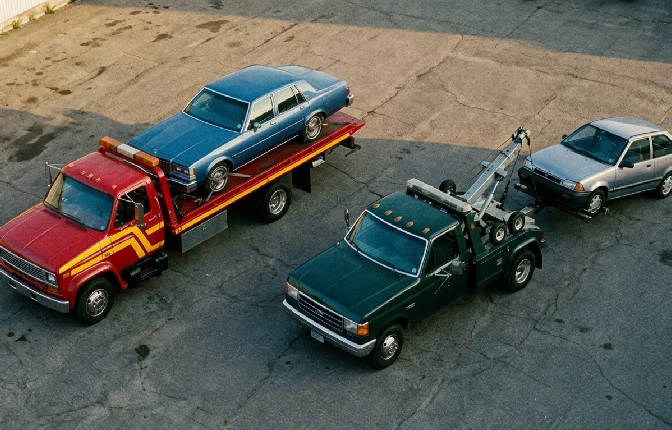
Flatbed towing places the whole vehicle onto a truck platform, with no wheels touching the road. Wheel-lift towing raises two wheels while the other two roll behind the truck, making each method suitable for different towing situations.
The right choice between flatbed towing and wheel-lift towing depends on your vehicle’s drivetrain, condition, ground clearance, pickup location and travel distance. Sharing these details with a towing professional helps ensure the right tow truck is sent.
What Is Flatbed Towing?
Flatbed towing is a vehicle transport method where the entire car is loaded onto a flat platform, keeping all four wheels off the road. The vehicle is secured to the platform before the tow truck moves it to the required destination.
Flatbed towing can be suitable for:
-
AWD and 4WD Vehicles:
Prevents the vehicle’s wheels from rolling during transport.
-
Damaged Cars:
Useful when a vehicle cannot safely be driven or has smash damage.
-
Low-Clearance Vehicles:
Helps reduce the risk of bumpers, body kits, or other low parts touching the road.
-
Luxury and Classic Cars:
Keeps the vehicle fully supported during transport.
-
Long-Distance Towing:
Suitable when a vehicle needs to travel further from its pickup location.
Vehicle manufacturers can have specific towing requirements, so the owner’s manual should also be checked.
What is Wheel-Lift Towing?
Wheel-lift towing uses a hydraulic lifting mechanism to raise either the front or rear wheels of a vehicle. The remaining wheels stay on the road as the vehicle is towed. This method can suit some standard vehicles when their drivetrain and condition allow two wheels to roll safely.
Wheel-lift towing can be suitable for:
-
Standard FWD Vehicles
Suitable for many front-wheel-drive cars, as long as two wheels can safely remain on the road.
-
Standard RWD Vehicles
Can suit rear-wheel-drive cars when the towing method is compatible with the vehicle.
-
Short-Distance Towing
A practical option for moving suitable vehicles over shorter local distances.
-
Restricted Access Areas
Useful where a smaller tow truck can access narrow streets, car parks, or tight spaces.
-
Roadworthy Rolling Vehicles
Suitable when the vehicle can roll freely and does not have major wheel, steering, or suspension damage.
However, the vehicle’s drivetrain and the manufacturer’s towing instructions should always be considered before using this method.
Flatbed vs. Wheel-Lift Tow Truck: Key Differences
| Feature | Flatbed Tow Truck | Wheel-Lift Tow Truck |
|---|---|---|
| How It Works | Vehicle loads onto flat platform | Hydraulic yoke lifts two wheels |
| Wheel Contact | No wheels touch the road | Two wheels remain on the road |
| Safety & Wear | Provides maximum vehicle protection | Suitable with proper drivetrain precautions |
| Best Vehicle Types | AWD, 4WD, luxury and damaged vehicles | Standard FWD or RWD vehicles |
| Mobility | Larger truck needs more space | Easier access in tight spaces |
| Towing Distance | Suitable for short and long distances | Best suited for short local distances |
| Cost | Generally costs more for towing | Generally more affordable for towing |
The correct choice is not simply about which tow truck arrives first. The vehicle’s condition, drivetrain, clearance, and towing requirements are all important factors.
How Do I Choose the Right Towing Method?
Selecting the right towing method depends on your vehicle and its condition. When booking towing in Melbourne, share these details with the towing operator:
- Vehicle Make and Model: Helps identify towing requirements.
- Drivetrain Type: FWD, RWD, AWD or 4WD.
- Vehicle Condition: Running, damaged, or non-running.
- Wheel Condition: Whether the wheels can roll.
- Vehicle Location: Pickup address and access conditions.
- Towing Destination: Workshop, home, or another location.
- Damage Details: Any mechanical issues, damage or faults.
Providing these details helps the towing team select the right tow truck and equipment for your vehicle.

Get The Right Towing Solution With West Link Towing
West Link Towing provides 24/7 towing services across Sunshine and the Western Suburbs of Melbourne, including car towing, emergency towing, roadside assistance, specialised towing, machinery towing, and plant equipment transport.
If you are uncertain whether your vehicle needs flatbed or wheel-lift towing, please contact us with your vehicle details and location. Our team can assess your towing needs and arrange suitable assistance. Call West Link Towing on 0492 332 *** for 24/7 towing service across Melbourne.
FAQs
Flatbed towing is often suitable for low-clearance cars because the vehicle is fully loaded onto the truck platform. This keeps the wheels off the road and can help reduce the chance of the vehicle’s bumper, underbody, or other low parts scraping during transport.
No, wheel-lift towing is not suitable for every vehicle. It can work well for some standard FWD and RWD vehicles, but the drivetrain, transmission, wheel condition, and manufacturer’s towing instructions should be considered first.
Yes, a flatbed tow truck can move a non-running car. A winch can pull the vehicle onto the flatbed when it cannot start or drive. The towing operator will consider the car’s condition, wheel movement, damage, and access before loading it.
Some electric vehicles can be towed with a wheel-lift, but only when the manufacturer allows this method for the specific model and drivetrain.
Flatbed towing in Melbourne typically costs around $120 to $250 for a standard local tow of about 10-20 km during regular business hours. The final price can vary based on the base call-out fee, towing distance, vehicle type, location, access and time of service.

